Blog

  • Letter to Your Wife on the Wedding Day: Plain and True

    Letter to Your Wife on the Wedding Day: Plain and True

    A letter to your wife on the wedding day is the only love letter you will write to her as her husband for the first time. She will probably keep it for the rest of her life. The good news is that it does not have to be long or clever to do its job. It has to sound like you on the page, the morning of, before the day pulls you both into a hundred conversations. Here is how to write one.

    Why the morning letter matters more than the speech

    Your speech will be heard by everyone. Her letter is for her alone. She will read it in a quiet room with hair half done and a cup of tea cooling on the dresser. Whatever you put on that page is the last thing she reads as just herself, before the day begins.

    The letter does not have to compete with the vows. The vows are for the room. The letter is for the woman.

    How to start when the words won’t come
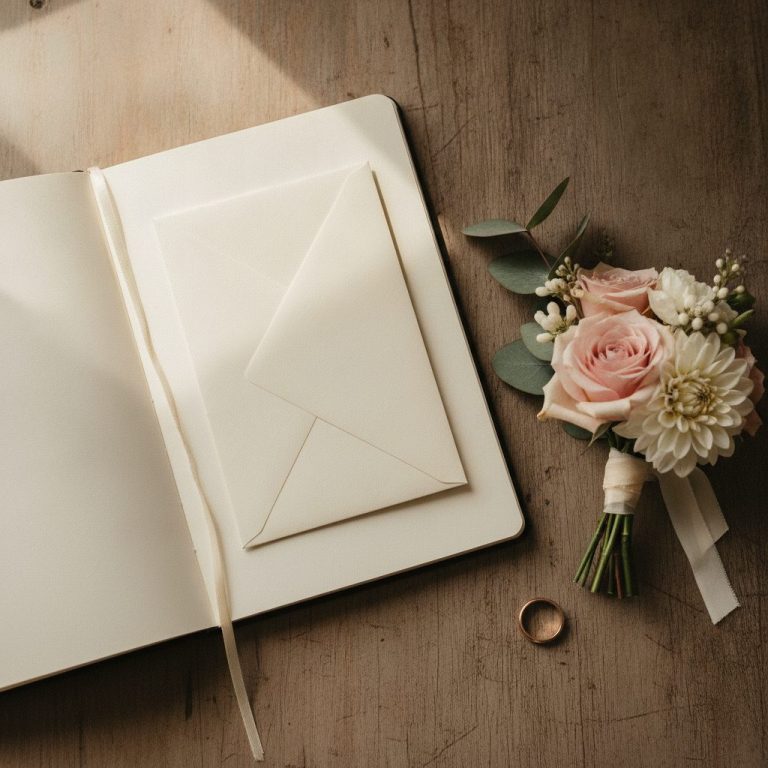
    An open journal page with a small bouquet of garden flowers and a wedding band, warm light
    Love Letters To Wife

    Open with where you are. “It is six in the morning and the house is quiet.” “I am writing this from the hotel room and your mother just brought up tea.” She can picture you straight away.

    Use her name. Her actual name, not “my bride.” This is the letter where her name carries the most weight it will ever carry.

    Name one moment from your time together that you keep coming back to. The night you first knew. The trip neither of you wanted to come home from. The day she said yes. One. Not a list.

    Pair it with what it told you about her. “I knew that night that I wanted to make the rest of my life with someone who laughed like that.” The pairing is what makes it land.

    What goes in the middle

    One short paragraph for the thing about her that you do not think she knows you have noticed. The way she takes care of her sister. The way she pretends not to be scared when she is. The way she keeps a list of birthdays in her head. Specific to her.

    One short paragraph about today, in her words, not in wedding photographer language. What you are looking forward to seeing her do today. The walk down. The first dance. The face she will make when her dad gives a speech. Not the venue, not the flowers, her.

    One plain sentence about what you are promising her, in your own words, not the vows. “I will be the person who knows you best for the rest of my life” works. “I am yours for the rest of mine” works. One sentence.

    How to close

    Close with what you wish for her today, not for the marriage. “I hope you have a quiet ten minutes before the day starts.” “I hope your dad makes you laugh.” “I hope you do not forget that I am there.” A wish, not a promise. The promises are coming later.

    Sign it with the name she calls you in private. The signature is the part she will look at twice.

    Examples to borrow from

    Wedding day letters from grooms to their brides.

    What to avoid

    • Long quotes from poets in place of your own line. She is marrying you, not Keats.
    • Recycling lines from your speech. She will hear the speech.
    • Apologising for the letter being short. Short is fine. Short is honest.
    • Promising things you are not sure you can do. The vows have weight, the letter has voice.
    • Writing it the night before in a panic. Write it a week in advance, then read it again the morning of.

    Frequently asked questions

    What do you write in a letter to your bride on the wedding day?

    Open with where you are and what time it is. Use her name. Name one specific moment from your relationship and what it told you about her. Add one plain sentence about what you are promising in your own words, not the vows. Close with a small wish for her day, not for the marriage. Sign it with the name she calls you in private.

    How long should a wedding day letter to my bride be?

    One page or less. The letter will compete with hair, makeup, family, photographers, and a hundred small interruptions. A short letter she can read in two minutes, twice, will mean more than a long one she only gets through once. Keep it tight.

    How do I get the letter to her on the day?

    Give it to her sister, her mother, or whoever is with her in the morning. Or leave it in her getting ready room before she arrives, tucked into her bag or laid on the dresser. Do not text it. She needs to hold paper that morning.

    What if I am not good with words?

    Good. Most of the best wedding day letters are written by grooms who are not. Use the words you would use if it were just the two of you in the kitchen. Short sentences. Real names. One memory. Done.

    Further reading

    For a wider look at how love letters live alongside the big moments, see the New York Times’s Modern Love feature on the letters of love, on the ones people write at the start of something rather than the end.
  • Birthday Love Letter for Your Husband (That Beats a Card)

    Birthday Love Letter for Your Husband (That Beats a Card)

    A birthday love letter for your husband is the easiest letter to write badly and one of the most powerful to write well. The card he opens on the day will be lovely and forgotten by Friday. A letter, tucked inside or handed over separately, gets kept. Here is how to write one that sounds like the year you actually shared, not a verse pulled from a shelf in a shop.

    Why the letter beats the card

    The card carries the date. The letter carries the year. Cards are written for everyone, which is why most husbands read them once and put them back in the envelope. A letter is written for him, by you, about this year, and that is the part that lands.

    You also do not have to be a writer to do this well. The letters husbands keep are not the ones with the prettiest lines. They are the ones with the most specific ones.

    How to start when the words won’t come

    Two coffee cups beside a folded letter on a wooden kitchen counter, morning sun
    Love Letters To Husband

    Skip the birthday opening. “Happy birthday” is what the card is for. Open the letter with something that happened between you in the last twelve months. A trip, a hard week, a Tuesday you remember for no reason.

    Use his name in the first line. Not “my love.” His actual name. It pulls the letter out of the generic and into your house.

    Pick one year, his year, not the marriage. What was this year like for him? What did he carry that you watched him carry? Name one specific thing he did this year that you have not properly thanked him for.

    Add one thing about who he is now that he was not a year ago. People change in small ways and most of those changes go unsaid in a long marriage. Saying one of them out loud is a real birthday gift.

    What to include from the year

    Three small details from the last twelve months are the rhythm. A song he had on repeat. A meal he cooked that you still talk about. The way he handled a phone call from his sister. Specific. Recent. Only the two of you would know.

    One harder thing, if there was one. The week his father was in hospital. The month he was looking for work. Pretending the year was all light makes the letter sound like a card. Naming one hard thing makes it sound like a real life.

    One plain sentence about what he means to you now. Not a metaphor. “You are the kindest person I know.” “You make our house make sense.” “I am still glad I chose you.” One. Not three.

    How to close a birthday letter

    Close with a small wish for the year ahead, not a list. A walk you want to take with him. A weekend you want to plan. A quieter year, if the last one was loud. One wish that sounds like the two of you, not like a calendar of resolutions.

    Sign it with whatever you call each other at home. The signature is the part he will look at twice.

    Examples to borrow from

    Birthday letters from wives at different stages of marriage.

    What to avoid

    • Counting his age in the first line. He knows how old he is.
    • Quoting the speech you gave at his last birthday party. The letter is private.
    • Listing every birthday you have spent together. Pick one moment from this year.
    • Pretending the year was all good if it was not. He knows.
    • Lines that sound like they could be on a mug. If you would not say it at the kitchen sink, cut it.

    Frequently asked questions

    What do you write in a birthday love letter to your husband?

    Skip the birthday opening, name one specific thing from the last twelve months, and say one plain sentence about who he is to you now. Close with a small wish for the year ahead, not a list of plans. Sign it with whatever you call each other at home.

    How long should a birthday letter to my husband be?

    One page is plenty. Long birthday letters can feel like a speech he did not ask for. Aim for something he can read in three minutes and re-read for years. The specifics carry the letter, not the length.

    Should I give him the letter on the day or before?

    On the day is fine, in private. Slide it across the breakfast table or leave it on the pillow that morning. Avoid handing it over in front of family at his birthday dinner, he will not be able to read it properly with people watching him.

    What if I always write him a card and never a letter?

    Start this year. The first letter does not have to be long. Half a page in your everyday voice will mean more than another card. Most husbands keep the first letter their wife writes them for the rest of their lives.

    Further reading

    For a longer look at why personal letters still matter, see the Smithsonian’s piece on the letters of Frida Kahlo, a reminder that the most lasting love letters are written about one person in plain words.

  • Love Letter to Your Husband After a Fight: The First 100 Words

    Love Letter to Your Husband After a Fight: The First 100 Words

    A love letter to your husband after a fight is not a peace treaty and it is not a confession. It is a quiet way to say the things that did not come out clean in the room. The first hundred words matter most. Get those right and the rest of the letter writes itself. Below is how to start, what to leave out, and a few letters from wives who have written this one too.

    Why a letter after a fight works better than another conversation

    After an argument, you are both tired. Words go sideways. The same sentences you tried to say in the living room start to sound like blame the second they leave your mouth, even when you do not mean them that way.

    A letter slows everything down. He gets to read it without having to respond on the spot. You get to choose the words you actually mean. The fight does not have to be re-fought to be repaired.

    The first hundred words

    Two coffee cups beside a folded letter on a wooden kitchen counter, morning sun
    Love Letters To Husband

    Start with the truth of where you are, not where you wish you were. “I am still upset and I am writing this anyway” is a kinder opening than “I have been thinking and I am over it.” He can tell the difference.

    Name what the fight was about in one sentence, your version of it. Not his. Yours. “I was hurt when you said the thing about my mother on Sunday.” Specific. Owned.

    Say what you wish you had said in the moment. Plain. “What I wanted to say was that I felt small.” That sentence is the reason for the letter.

    Close the first paragraph by stating what the letter is for. “I am writing this because I want us back to ourselves, not because I want to win.” That line frees both of you.

    What goes in the middle

    One short paragraph naming a thing he did right that you have not said since. Not as flattery. As a reminder, to both of you, that the fight is not the whole of the marriage.

    One short paragraph taking your share. Most fights have two people in them. Naming your half is not weakness, it is the move that lets him do the same without losing face.

    If there is one specific thing you would like to be different, say it now in one clear sentence. Not a list. One. “I would like us to not talk about money when one of us is tired.” Soft, specific, doable.

    How to close

    End on a wish, not a question. “I hope we can sit down for a coffee tomorrow without the weight of Sunday on us.” A wish does not demand a response. A question does. He needs to read the letter without feeling cornered.

    Sign it with whatever he calls you at home. Pet name or first name, not “your wife.” Keep the letter inside the relationship, not above it.

    Examples to borrow from

    Letters from wives who wrote one after a hard week.

    What to avoid

    • Listing every other time he has done the same thing. The letter is about this week, not a record book.
    • Apologising for things you do not actually regret to make the letter softer.
    • Asking him to write one back. Letters work better when they are not transactions.
    • Threatening or hinting at consequences inside the letter. Save those for a calmer conversation.
    • Quoting things he said in the fight back at him. Paraphrase, or leave it out.

    Frequently asked questions

    How soon after a fight should I write the letter?

    Wait until you can write the first line without your hand shaking. That can be an hour, it can be a day. The letter does not have to be fast to be honest. If you write it while you are still angry, leave it on the table overnight and read it again in the morning before you give it to him.

    What if I am still right and he is still wrong?

    You can write that letter too. Honesty does not mean pretending you have changed your mind. You can name what you stand by, take your share of how it played out, and still want the marriage to be okay. Both can be true on the same page.

    Should I give him the letter or read it to him?

    Give it. Reading it out loud while he watches you puts him on the spot and most husbands shut down. Hand it over, walk into the next room, and let him have it alone. He will come and find you when he is ready.

    What if he does not write back?

    Most husbands do not. Many will not say anything for a day or two. Look for him being softer in small ways, a cup of tea made without asking, a hand on your back at the sink. That is the reply. The letter does its work even when no words come back.

    Further reading

    For a wider view on how written words still mend things spoken ones cannot, see The Cut’s essay on love letters and Modern Love, which sits with the kinds of letters most people write when they do not know what else to do.

  • A Letter to Someone You Miss: When the Words Need to Land Anyway

    A Letter to Someone You Miss: When the Words Need to Land Anyway

    A letter to someone you miss is one of the hardest letters to write because you are writing into silence. You do not know if they will read it. You do not know if they want to. You write it anyway. Below is a way to put it on the page, plus letters from other people who did.

    Why writing it matters even if you do not send it

    Missing someone has a way of sitting in your chest until you do something with it. A letter is one of the quieter ways to do that. You take the feeling out of you and put it onto a page where you can look at it.

    Some of these letters get sent. Many do not. Both kinds are real. A letter you wrote and kept is still a letter, and the writing of it still does something for you.

    How to start when the words won’t come

    A folded letter inside a red-and-blue chevron airmail envelope with a single stamp
    Long Distance Love Letters

    Write the date and where you are. “Sunday, the kitchen, just before midnight.” It sounds small, but it tells your brain you have already begun.

    Start with one specific thing you miss. Not the whole person. One thing. The way they laughed when they were not expecting to. The smell of their jumper. The voice note they sent on Tuesdays. One thing is the way in.

    Say what you would say if they were in the room. Plain. Unguarded. “I miss you,” “I think about you on the way to work,” “I am sorry for how it ended.” The letter is for the things you cannot fit in a text.

    Close with what you wish for them, not for yourself. “I hope you are well,” “I hope someone is taking care of you,” “I hope you are happy where you are.” A wish carries less weight than a request.

    Who these letters are for

    Someone in another country. Someone you broke up with and never finished talking to. A friend who drifted. A parent you have not spoken to in a year. Someone who died before you could say it. The letter works for all of them, because the shape is the same. You miss them. You are writing it down.

    If the person you miss has died, the letter does not lose its point. Many people keep these letters in a bedside drawer and read them once a year. The page becomes a place to talk to someone who can no longer answer.

    Examples to borrow from

    Letters from people writing into different kinds of silence.

    If you are going to send it

    Wait a day before you decide. Write the letter, leave it on the table, sleep on it. In the morning, you will know whether the letter is for them or for you. Both are fine. Only one of them needs a stamp.

    If you send it, do not ask for a reply inside the letter. “I am not expecting you to write back” is a kinder line than “please write to me.” It frees them to read the letter without having to perform a response.

    Put your return address on the envelope anyway. Whether they answer or not is theirs. Whether they can find you is yours.

    If you are not going to send it

    Date the letter and put it somewhere safe. A drawer, a notebook, a folder on your laptop. Letters that are never sent still count, and many of them get read again later in life by the person who wrote them.

    Some people burn the letter once they have written it. The writing was the point, the letter has done its job, the paper can go. That is allowed too. There is no rule.

    What to avoid

    • Listing every reason you miss them. Pick one specific thing.
    • Demanding contact. A letter that demands a reply turns into a request, not a gift.
    • Writing in poetry when you would normally write in plain text.
    • Apologising for writing the letter. You are allowed.
    • Re-reading it five times before sending. Read it once, fix the typos, send it.

    Frequently asked questions

    What do you say in a letter to someone you miss?

    Start with one specific thing you miss about them, not a general statement. Say what you would say if they were sitting in the room with you. Keep the sentences short. Close with a wish for them, not a request from you. Sign it with your name.

    Should I send the letter or keep it?

    Write it first, then wait a day. In the morning you will know whether the letter is for them or for you. Letters kept in a drawer still do their work for the person who wrote them. Sending is optional, writing is the point.

    What if the person I miss has died?

    You can still write to them. Many people do. The letter becomes a place to say what was left unsaid, and most readers find it helps. Keep the letter somewhere safe and read it again on the anniversary if it brings you closer.

    What if I do not know what I miss exactly?

    Write that down as the first line. “I do not know what I miss about you, only that I do.” Honest opening lines are often the best ones. The specifics tend to come once the pen is moving.

    Further reading

    For a writer’s take on why missing someone still drives people to paper, see Lit Hub’s The Radical Act of Writing a Love Letter, on what the form gives you that the phone cannot.

  • Love Letter for Him to Make Him Cry: The Specifics That Land

    Love Letter for Him to Make Him Cry: The Specifics That Land

    The phrase “a love letter to make him cry” gets searched a lot, and it is worth being honest about what it actually means. A letter that moves him is not a letter that tries to. It is a letter built out of specifics only the two of you know. Below is how to write one without performing, and a few real letters that did the job for the writer who sent them.

    What “makes him cry” really means

    It is not about heavy words. It is not about saying “forever” five times. The letters that land for men are usually short, plain, and full of small details he did not know you noticed.

    The crying, if it happens, comes from being seen. Most men do not get letters that show them they are seen. When one arrives, the feeling that hits is recognition, not romance.

    So the goal of this letter is not to manipulate a reaction. The goal is to write something true enough that it would move you if someone wrote it to you.

    How to start when the words won’t come

    A folded handwritten letter on a wooden desk with a fountain pen, warm morning light
    Love Letters To Him

    Name one specific moment from the last month. Not the relationship as a whole. One. The way he laughed at something his nephew said. The thing he did for you on a Tuesday that you never thanked him for. The way he sat with you at the hospital.

    Start the letter there. “I have been thinking about the way you held my hand last Wednesday.” The reader is already inside the moment with you.

    Pair the small thing with what it told you about him. “I have been thinking about the way you held my hand last Wednesday. It told me something I do not think you would say out loud.” The pairing is what does the work.

    The specifics that actually land

    Pick three details only the two of you know. A song that came on in the car the night you first said you loved him. The way he says your name when he is half asleep. What he did when your dad got sick. The thing he said that you have been carrying since.

    Use his real name in the opening line. Not “my love.” His name. It tells him before he reads a word that this letter is for him, not a generic him.

    Avoid lines you have seen on Instagram or in a card. If a sentence sounds like it could be on a mug, cut it. The letters that move men are the ones a card company could never sell.

    The one sentence in the middle

    Somewhere in the letter, say one plain thing about him in your own voice. Not a metaphor. “You are the kindest person I know.” “I have not felt safer with anyone.” “I am proud to be the one you come home to.” One sentence. Not three.

    That sentence is the one he will remember. The rest of the letter sets it up, and the close lets it sit.

    Examples to borrow from

    Letters from women whose partners read them twice and then put them in a drawer.

    What to avoid

    • Trying to make him cry. He can tell when you are aiming at a reaction. The letter then becomes about you, not him.
    • Lines that sound like a wedding vow when there is no wedding.
    • Long paragraphs. Short lines hit harder.
    • Listing every reason you love him. Three is the rhythm, not ten.
    • Pretending the relationship is easier than it is. He knows.

    How to give it to him

    In private. On a normal day. Not at a restaurant. Not in front of his friends. Leave it on his pillow, in his work bag, on the steering wheel of his car. He needs to be alone with it to feel anything.

    Do not stand next to him while he reads it. Watching him puts him on stage. Hand it over and walk into the next room. Let him have it. He will come and find you when he is ready.

    If he says nothing about it for a week, that is normal. Some men carry these letters around in their wallets for years and never bring them up. The silence after is part of how the letter lands.

    Frequently asked questions

    What do you write in a love letter to a man that will move him?

    Open with one specific moment from the last month, not a feeling. Name three small details only the two of you would understand. Say one plain sentence about who he is to you, without metaphor. Close with a wish, not a question. Sign it with the name he calls you at home.

    How long should the letter be if I want it to hit hard?

    Shorter than you think. A page or less. The letters that move men most are usually the ones they can read in two minutes and re-read for years. Long letters start to feel like performance. Short ones feel like the truth.

    What if I am not a good writer?

    Good. The best letters in this category are written by women who are not. The specifics carry the letter, not the prose. If you sound like yourself on the page, the letter will land. If you sound like a card, it will not.

    What if he does not react the way I hoped?

    That is normal. Men often process these letters in private, sometimes hours or days later. Look for the letter still being in his bedside drawer in a year. That is the reaction, even if he never says it out loud.

    Is it okay to write this letter early in a relationship?

    Yes, if you keep it short and you write what is true now. A four sentence letter in a new relationship is more honest than a page of promises. Write about what you have noticed about him in the months you have known him, not where you think the relationship is going.

    Further reading

    For more on why specific letters land harder than sweeping ones, The Marginalian’s piece on the love letters of John Keats to Fanny Brawne is worth a slow read. Keats’s letters work for the same reason a good one to your partner does: he writes about her, not about love.

  • Love Letters to My Wife: Plain Words That Mean Something

    Love Letters to My Wife: Plain Words That Mean Something

    A love letter to your wife does not have to be a poem. It can be a page about one Tuesday, the way she made the coffee, what she said on the phone to her mother that you have been thinking about since. The point is that you sat down on purpose to write it. Below are letters from husbands, and a small frame for writing your own.

    Why writing one matters when you already live together

    You stop saying the things you said when you were dating. The feelings are still there. They just live underneath the laundry and the school run and the broken washing machine.

    A letter is one way to put them back on the surface. It is also something she can keep. Spoken love disappears as soon as one of you starts the kettle. A letter stays in the bedside drawer for years.

    How to start when the words won’t come

    An open journal page with a small bouquet of garden flowers and a wedding band, warm light
    Love Letters To Wife

    Pick a week, not a marriage. Write about the last seven days. What did she do that you noticed and never said out loud? Start there.

    Use her name in the first line. Not “my love,” not “darling,” her actual name. It pulls the letter out of the generic and into your life.

    Pair one small thing with one large thing. The small thing makes the large thing land. “You let me sleep in on Sunday. I am not sure I would have got through this year without you.” The first sentence earns the second.

    Sign it the way you sign cards in the house. She knows your handwriting. She will know the letter is real before she reads a word.

    The five part frame, if you want one

    If a blank page is the problem, try the same frame as the love letter template: a soft opening line, three specific memories, what you want her to know, a quiet close, and your name. That is the whole shape.

    Three memories is the rhythm. A meal she cooked, a thing she said in the car, a moment in the hospital waiting room. Three. More than that and the letter starts to drift.

    The one plain sentence in the middle is the hardest part. “I love you,” “I am proud of you,” “I am glad I married you,” “I am sorry.” Say it without a metaphor. Metaphors make it look like a card.

    Examples to borrow from

    Letters written by husbands to wives of one year and of forty.

    When to give it to her

    Ordinary mornings work better than big occasions. A letter on a Tuesday surprises her in a way a letter on her birthday cannot. The birthday letter is expected. The Tuesday letter is a gift she did not see coming.

    Leave it where she will find it on her own. On her pillow, in the book she is reading, tucked into her bag, on the kettle. Watching her read it puts pressure on the moment. Let her have it alone.

    If she reads it and only says “thank you,” that is okay. Some wives keep these letters in a drawer and never bring them up. Quiet is not the same as not caring.

    What to avoid

    • Listing every nice thing she has ever done. Pick a few, recent ones.
    • Lines that sound like the speech you gave at the wedding.
    • Using the letter to bring up an argument. Write the argument letter separately if you need to.
    • Apologising for being sentimental. You married her, you are allowed.
    • Quoting song lyrics in place of your own words. One line of a song is fine if it is meaningful to you both.

    If you have not written one in a while, or ever

    Most husbands have not written a love letter since they were twenty. That is fine. You are not auditioning. The letter does not have to be good in a literary sense. It has to sound like you on the page.

    If it helps, type the draft first and then copy it out by hand. A handwritten letter does something a typed one cannot, and you can read more about that on the handwritten love letter page.

    Once it is written, leave it for an hour. Come back. Fix the typos. Do not polish the feeling out of it. The slightly clumsy sentences are often the ones she will read twice.

    Frequently asked questions

    What do you write in a love letter to your wife?

    Start with one specific moment from the last week or month, not a grand summary of the marriage. Name a small thing she did that you noticed. Say thank you, say I love you, and say one thing you hope for the year ahead. Sign it with whatever name she calls you by at home.

    How long should a letter to my wife be?

    One page is plenty. Long letters in long marriages can feel like a lecture. Aim for something she can read in three minutes and re-read for years. The point is not length, it is that she hears your voice on the page.

    What if I am not the romantic type?

    Good. The best letters from husbands are usually written by men who are not. Use your everyday voice, not poetry. Say what you would say if you were brave enough at the kitchen sink. She married you, she knows that voice.

    When is a good time to give her the letter?

    An ordinary morning is better than a big occasion. Birthdays and anniversaries already carry expectation. A letter on a Tuesday, left on her pillow or in her bag, lands harder because nothing prompted it.

    What if she does not say much when she reads it?

    That is normal. Some wives read these letters three times in private and never talk about them. The letter has done its job if she keeps it. Look for it in her bedside drawer in a year. It will be there.

    Further reading

    For more on why writing love down still matters, see the BBC’s piece on the most famous love letters in history, which traces the form from Napoleon to Frida Kahlo.

    For a contemporary take, NPR’s Letters of Love and Longing Keep Couples Connected looks at how letters still hold marriages together across distance and decades.

  • Anniversary Love Letter: For Year One, Year Ten, Year Forty

    Anniversary Love Letter: For Year One, Year Ten, Year Forty

    An anniversary love letter has one job. It marks a year you spent with someone and says, in plain words, that the year mattered. The shape of the letter changes with the number on the card. A first anniversary reads different from a fortieth, and that is the point. Here is how to write one that sounds like the year you actually had.

    Why the year matters more than the date

    Anniversary cards all say the same thing because they have to. They are written for everyone. Your letter is written for one person, about one year, and that is what makes it land.

    Start with the year, not the date. Not “happy anniversary,” not “another year together.” Start with one thing that actually happened between you in the last twelve months. The rest of the letter follows from there.

    How to write the year one letter

    A small stack of envelopes tied with twine beside a single rose on a wooden table
    Occasions

    Keep it short. A first anniversary letter that runs three pages is reaching. You do not have twelve years of memory to draw on yet. You have twelve months, and most of those months were figuring out how to share a fridge.

    Write about one or two things you learned about them this year that you did not know on the wedding day. The way they handle a hard week. What they are like when they are tired. The way they say sorry. Those are the real first anniversary lines.

    Close with a small wish for year two. Not a list. One wish. A trip, a habit, a quiet room.

    How to write the year ten letter

    By ten years, the easy lines have been said. The letter has to dig a little. Pick one year out of the ten and write about that. The year the baby arrived. The year you moved house. The year one of you lost a parent.

    Name one thing they did in that year that you have never thanked them for properly. The letter is for that thank you. Everything else is around it.

    Close with a line about the next ten. Not a promise. A direction. “I want to keep doing this with you.” “I am still glad I chose you.” Plain.

    How to write the year forty letter

    A fortieth anniversary letter is allowed to be quiet. You do not need to summarise four decades. You cannot. Pick one ordinary moment from the last month and let that stand in for the whole life.

    The watering of the plants. The way they hum in the kitchen. The way they hold your hand in the doctor’s waiting room. The small things at year forty carry the weight that grand statements carry at year one.

    Sign it with the name they called you the first year you knew each other. That alone will do something a hundred lines of writing cannot.

    Examples to borrow from

    Anniversary letters from couples at different points along the road.

    What to avoid

    • Counting the years in the first line. They know how many years it has been.
    • Listing every place you have lived. Pick one address that mattered.
    • Promises about the future you are not sure you can keep.
    • Quoting your wedding vows back at them. The vows already happened.
    • Writing the letter on the back of the card. Use a separate sheet, even a plain one.

    If the year was hard

    Say so. An anniversary letter that pretends the year was easy when it was not reads false. “This was a hard year for us. I am glad we got through it together” is a stronger opening than any line about forever.

    The honest anniversary letter is often the one that gets kept. The pretty one ends up in a drawer with the cards. The honest one ends up folded in a book.

    Frequently asked questions

    What do you write in an anniversary love letter?

    Start with one specific thing from the year, not the date. Name a moment you shared, a hard week you got through, a small habit you have built together. Say one plain thing about what they mean to you now. Close with a small wish for the year ahead, not a grand promise.

    How long should an anniversary letter be?

    One page is plenty for any year. A first anniversary letter can be half a page. A fortieth anniversary letter can be three short paragraphs. Length does not prove the marriage. The specific details do.

    Should I give the card and the letter together?

    Yes, but keep them separate. The card carries the date. The letter carries the year. If you fold the letter inside the card, give it a second of weight by handing the card over first, then the letter.

    What if we are not big on anniversaries?

    Write the letter anyway and skip the rest. Many couples who roll their eyes at the date still keep the letter. You do not need a reservation. You need a sheet of paper and ten quiet minutes.

    Further reading

    For a longer view on why anniversaries still pull people to the page, see The Atlantic’s The Lost Art of Love Letters, on what a written record does that a text thread cannot.

  • Getting in the Mood to Write a Love Letter: 7 Quiet Rituals

    Most people freeze the second the page is in front of them. The problem is rarely the words. It is the room, the light, the noise in your head, the phone three inches from your hand. Move those, and the words usually come. Here are seven quiet rituals that get most people unstuck.

    None of them are about being precious. They are about lowering the volume long enough to hear yourself.

    1. Find a quiet room and shut the door

    This sounds obvious and it is the one most people skip. A love letter written on the sofa with the television on in the background reads like a letter written on a sofa with the television on. The reader can tell.

    You do not need a writing nook. The kitchen table after everyone has gone to bed works. The car in the supermarket car park works. Anywhere you can be alone with the page for half an hour.

    Put the phone in another room. Not face down. In another room.

    2. Light a candle, or pour something

    A small physical change tells your brain something is about to happen. A candle, a coffee, a glass of wine, a cup of tea. Pick one. It is a ritual, not a recipe.

    The point is to mark the moment. You are not just sitting down. You are sitting down for this. That tiny shift moves a letter from “I’ll do it later” to “I am doing it now.”

    3. Put on the right music

    Lyrics will pull your sentences toward the song. Skip lyrics. Pick something that sets a tone and stays out of the way.

    Five that work for most people:

    • Nils Frahm, “Says.” Slow, building, no words.
    • Max Richter, “On the Nature of Daylight.” The shortcut to feeling, used in too many films because it works.
    • Olafur Arnalds, “Near Light.” Quiet enough to write under.
    • Erik Satie, the Gymnopedies. A hundred years old and still the right tempo.
    • Brian Eno, “Music for Airports.” Ambient, no edges, lets your own thoughts come forward.

    If none of those land, pick the album you played in the car on a trip you took together. Familiar instrumental music gives your brain something to lean on without competing with the words you are choosing.

    4. Walk first

    Twenty minutes outside before you sit down. No headphones, no podcast, no audiobook. Just the walk.

    Walking shakes things loose in a way sitting at a desk cannot. The lines you have been trying to find at the kitchen table will arrive somewhere between the second corner and the way back. Lit Hub’s piece on the radical act of writing a love letter calls the form a slow act on purpose, and the walk is the slow part of the slow act.

    Take a small notebook. Write down two or three lines before you forget them. Do not try to write the letter on the walk. Just catch the seeds.

    5. Look at a photo of them

    One photo. Not a scroll through your camera roll. A photo where they are doing something normal: cooking, laughing at something offscreen, sitting on a beach you have been to together.

    Hold the photo for two minutes. Notice one thing in it you have never described out loud. The way their hands sit. The shirt they wore that summer. The light on the side of their face.

    That noticing is the beginning of the letter. The line you would write under the photo is the line you put in the letter.

    6. Free write for five minutes

    Set a timer. Write whatever comes for five minutes. Do not stop. Do not correct. Do not edit. If you cannot think of anything, write “I do not know what to write” until you do, which will usually be inside the first minute.

    Most of the five minutes will be rubbish. One sentence out of the five minutes will be the line your letter actually starts with. The free writing is the digging. The letter is what you find.

    This is the single technique that gets the most people unstuck. It works because it stops you trying to be good. You cannot be good and warm at the same time.

    7. Write longhand, even if you’ll later type

    Write the draft on paper. A page from a notebook is fine. The pen does not matter. Use whatever is in the drawer.

    Writing by hand slows you down. Slow is what you want. Slow is the difference between the line you would say and the line you would mean.

    If you are going to send the letter typed, that is fine. Type up the handwritten draft after, and most of what you keep will be from the handwritten version. The handwriting is not the destination. It is the way through. See a handwritten love letter for more on this.

    One more thing: drink water

    Sounds trivial. It is not. If you are dehydrated, the words come slower. A glass of water before you sit down is part of the ritual too.

    Once you are in the mood

    Read how to write a love letter for the six part frame. If you want a scaffold to start from, the love letter template gives you a shape you can fill in.

    Once the page has a few lines on it, the mood takes care of itself. The hard part is the first ten minutes. These seven rituals are about getting through those ten minutes, then getting out of your own way.

    Frequently asked questions

    How long should I spend on the mood before I start writing?

    Twenty minutes is enough for most people. The walk is fifteen, the candle and the water and the music take a couple of minutes between them, and then you sit down. Longer than half an hour and you are procrastinating, not preparing.

    What if I can’t find a quiet room?

    The car works. A cafe works if you have headphones in. A bench in a park works. The room is not the point, the lack of interruption is. Anywhere your phone can be off and no one will speak to you for half an hour is fine.

    Does the candle and music thing actually help, or is it just for show?

    It helps. Small physical cues tell your brain to switch into a different mode. The same way putting on running shoes makes a run feel more likely, lighting a candle and putting on quiet music makes writing the letter feel more likely.

    What if I do all of this and the words still won’t come?

    Read the page on what to say in a love letter when the words won’t come. Sometimes the issue is the mood, sometimes it is that you have not picked the moment to write about yet. Both are fixable.

  • What to Say in a Love Letter When the Words Won’t Come

    The hard part of a love letter is almost never the feeling. It is finding a way into the first sentence. Once one line is on the page, the rest comes. Here are three techniques that almost always crack open the first line, and three sentence starters you can borrow if you need a running start.

    Pick one. Try it. If it does not work, try the next. There is no right way and no wrong way, just the way that gets ink onto paper today.

    1. Start from a specific memory

    Pick one moment from the last month, the last week, or the last year. Not a feeling. Not a summary. A moment.

    The moment can be small. The time they made coffee on a Sunday without being asked. The look they gave you across the room at someone else’s wedding. The night they sat with you in A&E. The walk home from the pub last week when they made you laugh until your face hurt.

    Write one sentence about that moment. Then a second sentence about what you felt while it was happening. Then a third about why it has stayed with you. You now have a first paragraph.

    The reason this works is that specifics let you in. “I love you” is a sentence you have written a hundred times. “I have been thinking about Sunday morning” is a sentence you have never written before, and once you have written it, the rest of the letter has somewhere to go.

    2. The ‘I notice you’ technique

    Sit somewhere quiet and finish this sentence in your head five times: “I notice you …”

    I notice you check your phone before bed even though I have asked you not to, and I love that you keep doing it because it means you are still trying. I notice you sing when you cook. I notice you go quiet when you are reading something that matters to you. I notice the way you hold the steering wheel. I notice you always put the kettle on for me first.

    Most of those five will be too small to put in a letter on their own. One of them will not be. That one is the line you put in the letter.

    The technique works because love is mostly noticing. The reader will know, the second they read it, that you have been paying attention. The New York Times Modern Love column on letters picks out the same thing in the letters it features: noticing is the work, the rest is just words around it.

    3. The ‘what you don’t say out loud’ prompt

    Ask yourself: what is the thing I think about this person that I have never said to them?

    It might be a thank you. It might be a piece of pride. It might be a small worry. It might be a confession that you love them more than you let on day to day. It might be that you are grateful they came back after a hard year. It might be that you wish you had been kinder last Tuesday.

    Whatever it is, write that down first. Above the rest of the letter. Then write the letter around it. You may end up moving that sentence into the middle or the end, but starting the draft with the line you have been carrying around is how you make sure it actually makes it onto the page.

    This is the technique people skip because it is the scariest. It is also the one that produces the letters that get kept for twenty years.

    Three sentence starters to borrow

    If none of the above works, steal one of these. You can write the rest yourself.

    “I have been carrying this around for a while, so I am going to put it on paper.” Works for the letter you have been meaning to write for months.

    “I have always found it easier to write things than to say them, so here is what I have been wanting to say.” Works for the letter that is taking the pressure off a conversation.

    “I keep thinking about …” Works for anything. Finish the sentence with the specific moment from technique one, and you are off.

    None of these are clever. That is the point. A clever opening line makes the reader pause to admire the writing. A plain one makes them lean in.

    If you have a draft and you are stuck mid letter

    The middle of a love letter is where most people get tangled. The way out is usually to stop trying to summarise. Go back to specifics. Add another small moment, or one more thing you have noticed, or the line you have been thinking about that you have not put in yet.

    If you have written half a page and it sounds generic, the fix is almost always to add one true detail and cut three general ones. The letter gets shorter and lands harder.

    For ideas to draft from, see love letter ideas. For borrowed lines to work into the body or the close, see love letter quotes. For the full frame the letter sits inside, read how to write a love letter.

    Frequently asked questions

    Why can’t I find the right words even though I feel a lot?

    Because feeling is not the same as language, and the gap between them is where everyone freezes. The way through is to stop trying to translate the whole feeling at once. Start with one specific thing the person did or said, and write about that. The feeling will turn up in the writing on its own.

    What if the letter sounds boring when I write about specific moments?

    It will not. Specific is the opposite of boring. “You make me happy” is boring because anyone could say it. “You laughed at my dad’s joke last Christmas and I watched my mum decide she liked you” is not boring because only you could write it.

    How do I write a love letter to someone I do not know well yet?

    Use the ‘I notice you’ technique. New relationships have fewer shared memories, but the noticing has already started. Write about three things you have noticed. Keep the letter short. Half a page is plenty when you are six weeks in.

    What if I write the letter and it still does not feel like enough?

    It probably is enough, and you are reading it through the lens of what you wanted it to sound like rather than what the reader needs. Put it down for a day. Read it tomorrow. Almost every letter reads better the next morning than it did the night before.

  • Short Love Letter: How to Say a Lot in 50 Words

    Short love letters often land harder than long ones. A page of general feeling is easier to skim. Fifty words written carefully are harder to forget. The trick is the rule of one specific thing, and the trust that you do not have to say everything in one letter.

    Here is how a short letter works, three real ones to copy the shape of, and a quick guide to when short is the right call.

    Why short letters land hardest

    The reader can hold the whole thing in their head at once. A long letter has to be read in parts and reassembled. A short letter is a single moment, complete on the first read.

    Short letters also feel more honest. There is no room to perform. You either have the line that matters or you do not. Trying to pad a short letter falls apart immediately, so people stop trying. The letter ends up cleaner.

    People also re-read short letters. A page is read once and put down. Fifty words can be read three times in a row and they are still doing work on the third read. NPR’s Code Switch piece on letters of love and longing makes the case that the shorter, plainer letters in their archive are the ones the recipients say they re-read most.

    The rule of one specific thing

    A short love letter has room for exactly one specific thing. One memory, one noticing, one thank you. Not three. One.

    Pick the thing first, before you start writing. Once you have it, the letter is mostly already written. The rest is the line that introduces the thing and the line that closes the letter.

    If you cannot decide between two things, write two short letters. Send one this week, keep the other for next month. Splitting them keeps both clean.

    Three short letter examples

    Each of these is between thirty and sixty words. Each does the same job a five hundred word letter would do.

    Example one, three lines

    It is Tuesday, kitchen table, kettle just boiled. I keep thinking about the way you laughed last night at the thing your brother said and tried to pretend you were not laughing. I love you. I will see you tonight.

    Why it works: one moment, one plain line, one soft close. The reader can see the kitchen.

    Example two, four lines

    I do not always say it on the days you carry me. You carried me yesterday. I noticed. Thank you for being who you are when I am not at my best.

    Why it works: one specific thing (you carried me yesterday), one plain line, no padding. The shortness is what makes it land.

    Example three, five lines

    I am writing this in the car park outside work because I did not want to wait until tonight. I have been thinking about how lucky I am for about a week now and I figured I should tell you. That is the whole letter. Love you.

    Why it works: it is unmistakably from a real person, doing a real thing, in a real place. The letter sounds like the writer talking, and that is the only test that matters.

    When to keep it short, when to go long

    Keep it short when:

    • You have one specific thing to say and you do not need to wrap it up in context.
    • The relationship is new and there is not much shared history to draw on yet.
    • The letter is for an ordinary day, not a big occasion.
    • You are writing more often. A short letter every few weeks beats one long letter a year.

    Go longer when:

    • You are marking a big occasion (anniversary, a hard year, a goodbye).
    • You have a lot you have been carrying and need to put it down properly.
    • The letter is doing the work a conversation cannot, and the conversation would have been long.

    If you are unsure, start short. You can always add. Most letters that started short and grew end up better than letters that started long and were cut.

    How to write fifty good words

    Open with the moment, not the feeling. “It is Tuesday, the kitchen, the kettle just boiled.” Or “I am writing this from the train.” The reader is somewhere immediately.

    Then your one specific thing. One sentence. “I keep thinking about …” or “I noticed yesterday that …” or “Thank you for …”.

    Then the line you wanted them to hear. “I love you.” “I am proud of you.” “I am glad it is you.” Plain English, no metaphor.

    Then sign it. Done. The whole letter took you ten minutes.

    If you want borrowed lines for the open or the close, see love letter quotes. For more ideas to start from, see love letter ideas. The full frame any letter sits in, short or long, is on the page about how to write a love letter.

    Frequently asked questions

    How short is too short for a love letter?

    A line is too short. Two or three sentences is the minimum that reads as a letter rather than a note. Anywhere from thirty to a hundred words is the sweet spot for a short letter. Below thirty and it starts to feel like a text written on paper.

    Will a short letter come across as not caring enough?

    Not if it has the one specific thing in it. A short letter with a real moment in the middle reads as more thoughtful than a long letter with generic feeling. The length is not the signal of care, the specifics are.

    Can I write a short letter for a big occasion like an anniversary?

    You can, especially for an anniversary in a long marriage. After year fifteen, a four sentence letter on an ordinary morning can land harder than a page on the actual date. The format is freer than people think.

    How often should I write short letters?

    As often as you have one specific thing to say. Monthly works for a lot of people. Weekly is fine if the person you are writing to is open to it. Less than that, the practice loses its rhythm, and more than that, the letters start to feel less special.